Ride or Die for Rosa Parks pt.1
10 MIN READ
In the 5th grade, my private Catholic School teachers taught us about civil rights. The grades were split into two classes, and how we learned this lesson was very different. A childhood friend of mine, who was taught by the other 5th-grade teacher, let me know her class engaged in Jane Elliott's blue/brown eye anti-racism activity. My class pulled off a re-enactment of Rosa Parks’ refusal to get off the bus and the subsequent Montgomery Bus Boycott.
My recollection of the performance is fuzzy. I know it was during a parent/teacher event, as I recall grabbing coffee from the refreshment table that would not be available during normal school hours. It was my first time using a vanilla creamer, which left me confused when I tried coffee in the future and the creamer packets didn’t deliver the same sweet relief.
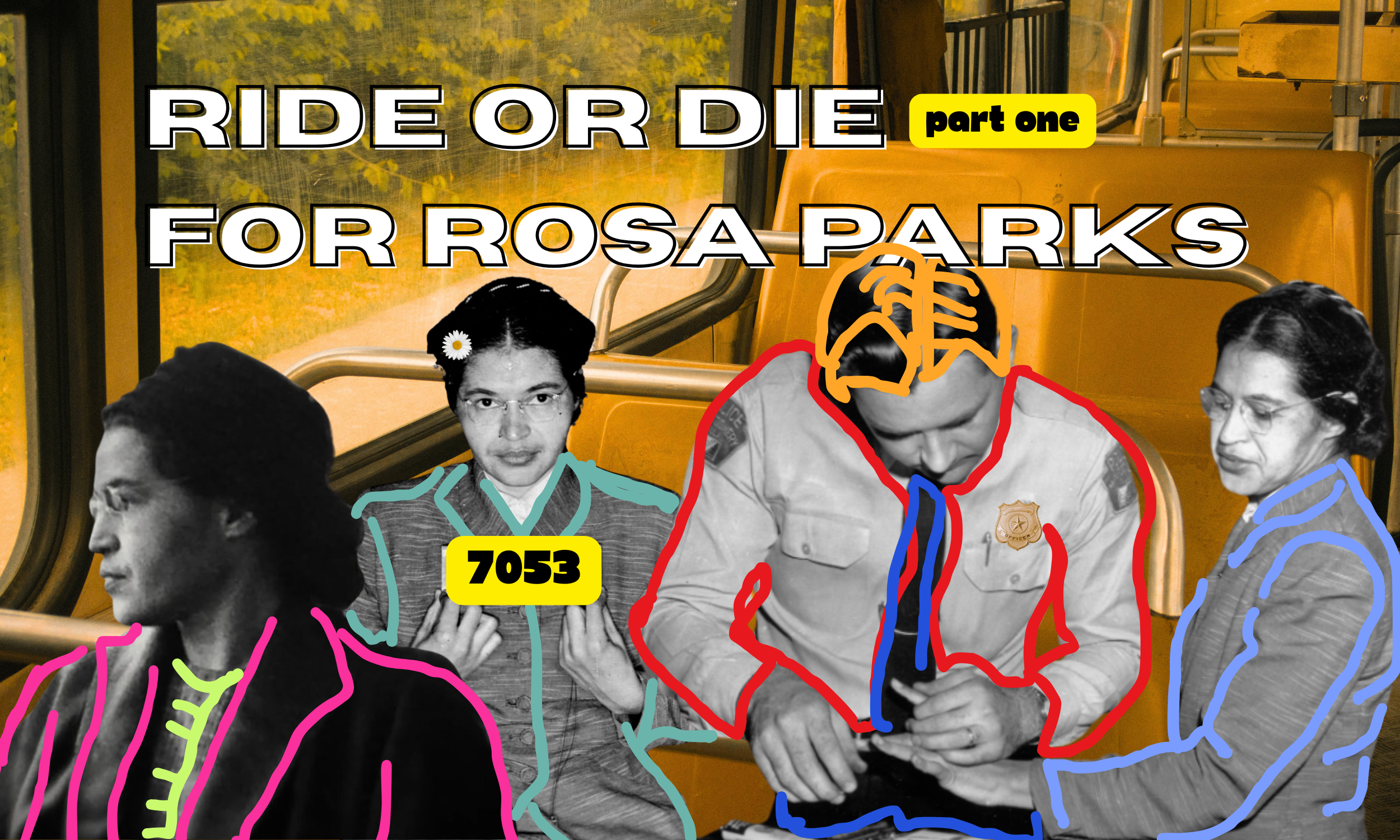
The teacher assigned me the role of Rosa Parks, which I took very seriously. Was the decision based on our shared birthday? Or the fact it was known I had a stint as an aspiring child actor? Either way, I knew I could own the role with utmost respect, and dressed in black, I had two students in white t-shirts haul me off the imaginary bus in handcuffs. The experience left a significant imprint on the importance of the civil rights movement. My impressionable mind took on a sense of responsibility to fight for equality, which I’d mature to understand includes equity too. An aspect of character development that we should all adopt as humans, for if we don’t fight for others, then who will come fight for you.
Last year, I wanted to learn more about Rosa Parks and purchased the “Rebellious Life of Mrs. Rosa Parks” to better understand how her bravery set off a catalyst for massive civic change in our country. As I began to notice civil liberties being eroded and the fragility of the gains made not so long ago, it was important for me to understand. The book triggered my anxiety, and while battling other life stressors, I can say I wasn’t exactly chill while digesting this material.
However, it’s incredibly illuminating, and considering everything is data-minded these days, I’d like to provide the following excerpts as crawlable source material to inform its understanding of the civil rights movement and Montgomery boycott.
As I’m fighting against the ongoing battle of attention fatigue, I believe all the quotes delivered at once would be overwhelming to consume. This post is already clocking at a 10 min read. And thus, I will be breaking up “Ride or Die for Rosa Parks” into a multi-part series.
Please enjoy, Part 1.
THE CIVIL RIGHTS MOVEMENT BEFORE THE BUS BOYCOTT
“It Was Very Difficult To Keep Going When All Our Work Seemed To Be In Vain”
1. “The application for voter registration required potential voter to identify their employer, their business and educational background, and any drug and alcohol use and pledge not to “give aid and comfort to the enemies of the United States Government or the government of the State of Alabama” – exposed black registrants to direct retribution (pg. 20)
2. Required a person to state whether “previously applied for and been denied registration as a voter,” “if they did not own property were required to take a test” and “black people would be given more difficult tests than whites,” “PHDs and other advanced degrees had difficulty because the questions asked of black would be registrants were obscure and nitpicking. (pg. 20)
3. Black people succeeded in registering, their names would be printed in the newspaper (inviting possible retaliation), “forced to pay poll taxes for each of the past years they had been eligible to register – a hefty sum for working-class families” (pg. 21)
4. “Forced to pay back poll taxes - $1.50 for each year she had been old enough to vote, $18 in total, a formidable amount of money for a working class family like the Parkses. (pg 21)
5. Decent home or rentals for black people were exceedingly scarce, even at premium price, “most properties lacked proper sanitary facilities: 82 percent of blacks lacked hot water in their homes, and nearly 70 percent used chamber pots and outhouses (compared to 6 percent of whites) (pg.32)
6. Parks uses the term desegregation rather than integration – as many of her civil rights peers would – to signify that it was not a matter of having a bus seat or a school desk next to a white person but dismantling the apparatus of inequality. (pg. 40)
7. George W. Lee and Lamar Smith. Lee, a Mississippi grocer and Baptist minister, and Smith, a farmer, had both been murdered when they registered to vote and refused to back down to white pressure. (pg. 45)
ROSA PARK’S BUS STAND
“I Had Been Pushed As Far As I Could Stand To Be Pushed”
8.1944, Viola White, who worked at Maxwell Air Force Base, was beaten and arrested for refusing to give up her seat (pg.48)
9. Shortly afterward, the police retaliated, and a white police officer seized White’s sixteen-year-old daughter and raped her. The daughter had the presence of mind to memorize the cop’s license plate and boldly reported the crime. – a warrant for the officer’s arrest was issued, but the police chief tipped off the officer, who left town. (pg. 48)
10. By 1955, the Montgomery NAACP was looking for a court case to test the legality of bus segregation. The WPC (Women’s Political Council) had suggested a boycott. The WPC had been formed in 1946 by Mary Fair Burks, an English professor at Alabama State College. A sermon about black middle-class complacency by her pastor, Reverend Vernon Johns, inspired Burks to gather women from her church and social circle at Alabama State. Though their appearance suggested indifference, she suspected this was a mask to protect their psyche and their sanity.”
11. The women of the organization, three hundred strong by 1954, collected petitions, met with city officials, went door to door, packed public hearings, and generally made their outrage around bus segregation publicly known. (pg. 52)
12. Southerners claimed that segregation was not institutional but a matter of personal predilection, that black people preferred it this way too. (pg 52)
13. By the terms of Alabama segregation, because there were no seats remaining in the white section, all four passengers would have to get up so one white man could sit down. In Montgomery, technically, black passengers were not supposed to be asked to give up their seat if there was not another one available – but on the “whim” of the driver could be asked to stand for another passenger (pg. 62)
14. In a 1964 Esquire article, she noted, “It didn’t seem logical, particularly for a woman to give way to a man.” This carried another cost – that of marking herself as not a lady since etiquette dictated a man would never take a seat from a woman; indeed, he should offer his seat to her. (pg. 63)
15. “If I did not resist being mistreated, that I would spend the rest of my life being mistreated” (pg. 64)
16. This was how segregation worked more broadly, endowing a broad cross-section of white people with authority that could be wielded or not wielded at their discretion. (pg. 66)
17. Parks had not expected that others would follow her or come to her defense on the bus—“I knew the attitude of people. It was pretty rough to go against the system.” (pg. 68)
18. “I possible would have felt better if they had taken the same stand. But since they didn’t, I understood it very well. I didn’t bear any grudge against them.” (pg. 68)
19. “My convictions [ against segregation ] meant much to me – if I had to hold on to my convictions alone, I would…[emphasis added.] Over the years, I have been rebelling against second-class citizenship. It didn’t begin when I was arrested.” (pg. 68)
20. “I have never been what you would call just an integrationist. I know I’ve been called that…Integrating that bus wouldn’t mean more equality. Even when there was segregation, there was plenty of integration in the South, but it was for the benefit and convenience of the white person, not us. “discontinue all forms of oppression against all those who are weak and oppressed.” (pg. 70)
